As parents, it feels good—great even —when our kids NEED us. When they turn to us for guidance, affection, even that peanut butter and jelly sandwich. Those are all good things.
We do have to remind ourselves, however, our long-term parenting goal is to guide our kids from being totally dependent on us to being independent thinkers and doers. That’s no overnight task.
It happens in all the little moments and lessons that occur in the day-to-day. From little steps like letting them pick out their own clothes to tying their own shoes, to helping them learn to weigh out what to spend their allowance on to choosing a college that suits them. Every little decision they make, right or wrong, along the way is a learning experience that will help lead them to be independent people we can be proud of.
Then, the thrill you get when you see them take on a task all by themselves and win at it? That’s awesome! If you’re eager to see more of that, let’s look at ways to help your kids embrace independence.
6 Tips for Raising Independent Children
Encourage effort: That perfection thing? It’s overrated and it causes a LOT of anxiety for kids. In fact, some kids are so locked into the fear of failure – they won’t even try. Instead, focus on the EFFORT. Encourage your kids to try new things, to go out of their comfort zones and be creative without the pressure to succeed or win or be perfect. When you do, they’ll be more willing to take on new tasks in the future.
Family contributions: Every member of a family plays an important role in a successfully running household. From setting out napkins to picking up toys – encouraging kids to contribute in age-appropriate ways teaches them that they are part of an indispensable team that needs them! This builds their confidence, and encourages them to want to do even more.
Promote problem solving. Curb your desire to jump in and fix. When a problem arises, wait. Give your child the opportunity to come up with solutions. Ask them “How?” questions. “How could you make your sister feel better after you took her action figure?” “How could you make sure you get up in time to make the bus?” If you want them to think for themselves, don’t provide all the answers.
Take Time for Training: Each week, work on learning something new in a fun and engaging way. As children learn new skills and tasks, they feel more confident in learning the next one. Who knows, they may even help YOU learn something new!
Turn over the reins: Every single day is filled with hundreds of choices. Apple or banana? Peanut butter or ham and cheese? Red shoes or blue? Allowing your children to make those small choices gives them a sense of control and dominion over their lives which leads to independent thinking. It also helps them take ownership of those choices – for some reason that peanut butter sandwich tastes SO much better since they picked it!
Structure as a safety net: Providing structured routines for mornings, afternoons and evenings gives your kids the safety net they need to try new things in a controlled environment. That helps keep them from feeling overwhelmed by the process, and helps you keep the peace!
Raising kids to be independent thinkers and to take a proactive role in their everyday lives is a little scary for some parents at first. Don’t worry, they’ll always NEED you. Teaching them to do things for themselves is just part of being an amazing parent. Think of it as a gift that keeps on giving!
For more ways to develop strong, independent children that listen more, behave better and are prepared for future success, join me for our next webinar, How to Get Kids to Listen Without Yelling, Nagging or Reminding.Find upcoming dates and times here. I promise you’ll come away with tools you can start using right away! See you online!
Is practice time a challenge for you and your child these days? Looking for a few ways to keep the joy in the work? Try these great ideas from The Practice Shoppe Blog! They also have a really fun collection of practice items to help make practice more joyful. Check out the shop here.
Sometimes you just need to add some spice to practicing. Here are what some of my teacher friends did with their practicing this week:
Katie Mattox from Mattix Music Studio: Having trouble getting back into practice? Make work into a game! Here’s our “train station game” from today with small tasks written on each station. Once you complete the practice goal or task, drive your train to the next station. We had to have a chocolate at the end, of course!
Asheley Watabe with The Gifted Music School, Sotto Voce Strings and Rocky Mountain Strings: It’s a super hero matching game– every time Jack does a task he gets to turn over one cup to see if he finds a match…. There are 20 cups! It’s awesome!
Kelly Stewart with The Gifted Music School: A few years back Koen Rens gave a silent masterclass. I loved how he used his violin to speak to the kids and communicate what he wanted them to do. We tried it at home. Genius! Suddenly she couldn’t sass, and more importantly, I couldn’t YELL.
Stacy Smith with the Gifted Music School and President-Elect of the Suzuki Association of Utah: Today’s practice game: Uno cards. Grab a bunch of uno cards. Get a bunch of different numbers, limit the word cards. Line them up on the stand. The kid picks the card, you pick what they do. For example: 5. “Ok, now you’re going to play 5 A major scales.” 3: “3 review pieces with a perfect wrist.” Big numbers are great for now exercises. Word cards are something you do- I usually demonstrated something but have awful posture. They always fix it! I forgot about this game until today, it worked wonders with my 5 year old. We got 45 min in without complaint.
Do you have a fun and easy practice game you’d like to share? Send a brief description and a quick photo to leslie@thepracticeshoppe.com.
The following was reprinted from this New York Times article written by SCOTT SONENSHEIN about saying NO, or rather, not saying yes (or worse–no, then yes!) to everything your child asks for. Enjoy!
Despite the temptation for parents to say yes to their children’s wishes, research shows there’s an insidious side to chasing after the newest thing others have. It fosters a sense of deficiency that can never be fully satisfied. First they want the doll, then all of the accessories — and of course the four-story Barbie mansion.
And so I’ve taken on the work of saying no sometimes. At first, not surprisingly, my daughters, aged 4 and 9, revolted. They called me a bad father and I got plenty of mean looks. But over time, they realized the fun that comes from a no. Now my daughters pretend that their Elsa doll plays with a package of Shopkins, giving both toys a second, and better, life.
It turns out that saying no pays off far beyond avoiding raising spoiled kids. When we always yield to our children’s wants, we rob them of the opportunity to find solutions by adapting what they already have. Kids who learn from denial realize at an early age that they won’t always have the perfect tool for every job. They might not know something, have something, or be something. But that’s not the end of pursuing goals — it’s the beginning of activating their resourcefulness to find another way.
Youngsters are naturally resourceful. Give toddlers a frying pan and all sorts of uses come to their minds. As adults, we’re stuck using it to make a stir-fry. Many years of chasing after things we don’t need erodes our own ability to make more out of what we already have. It also sets a bad example for our kids.
In one study, researchers asked elementary school children to help Bobo the Bear, a stuffed animal, reach his toy lion using some materials: building blocks, a pencil, an eraser, a ball, a magnet, a toy car and a wooden box.
As children grow older, their brains develop in ways that should make it easier for them to solve this type of problem. Indeed, the oldest children in the study (6- and 7-year-olds) reached the correct solution (i.e., using the wooden box to prop up the building blocks) faster, on average, than the younger participants, who were 5.
But there was one condition in the experiment when the younger children ended up outperforming the older kids. And it had nothing to do with innate talents or artistic tendencies.
The researchers made a subtle change in how they displayed the materials. Instead of laying them all out on the table, the researchers used the wooden box as a container to store everything else, such as the magnet and pencil. Upon seeing the box acting like a container, the older children struggled to expand it to anything beyond a container. For the younger children, the box remained just as flexible a resource as it was before.
Each time we acquiesce to our kids’ latest request to buy something, we subtly condition them that their resources have limited uses. An occasional veto will compel them, in this case literally, to think outside the box.
In American culture, abundance tends to be seen as a symbol of success, prompting some parents to say yes to things they can’t really afford. Witness the elaborate coming of age parties people across cultures and income levels throw for their children, even if it means going into debt.
Many people who grow up without much recognize resourcefulness as an essential skill to get by. Those of us fortunate to live in relative abundance can benefit from occasionally experiencing scarcity. To be sure, I’m not suggesting denying children a generous supply of things they actually need like healthy meals, warm clothes and love. But plenty of wishes we cater to teach the wrong message. By having children occasionally experience scarcity, we can help them solve problems more effectively.
In one study, a set of participants wrote a brief essay about a time in childhood when they didn’t have much, while a second set wrote about growing up having a lot. Afterward, the researchers presented both groups with a problem that required using Bubble Wrap in different ways. People assigned to the scarcity group had better solutions compared to the abundance group.
Why might thinking about scarcity lead people to view their resources more expansively? With abundance, people treat resources as what they appear to be on the surface, utilizing them in traditional ways. But when embracing scarcity, they give themselves freedom to use resources in new ways. Imagine the upside of a weekend full of “nos” — it’s likely to be one occupied with new experiences: invented games, a family dance party or time spent outdoors.
This strategy has worked wonders for our family, and I received the ultimate compliment after my older daughter’s most recent birthday party. It was “the best day of my life,” she gleefully told me. Instead of paying for a party, we had a scavenger hunt in a nearby park where we asked the kids to scour the area to find things they could use to solve challenges, like making containers to protect an egg from a 10-foot fall. There were three teams of kids, each with their unique combination from a variety of materials, including newspaper, cups, leftover Halloween jack-o’-lanterns, dirt, cotton and Bubble Wrap. The kids, naturally resourceful when we let them be, had a blast. And no eggs were broken.
All was good until we got home. “Can I open my presents now?” my daughter asked. “Yes,” I hesitantly replied. I’ll have plenty of other chances down the road for my next no.
The following is a repost of this article by Stephen M. Demorest, Professor of Music Education at Northwestern University. It sheds light on the common misconception of “being talented” or not. Enjoy!
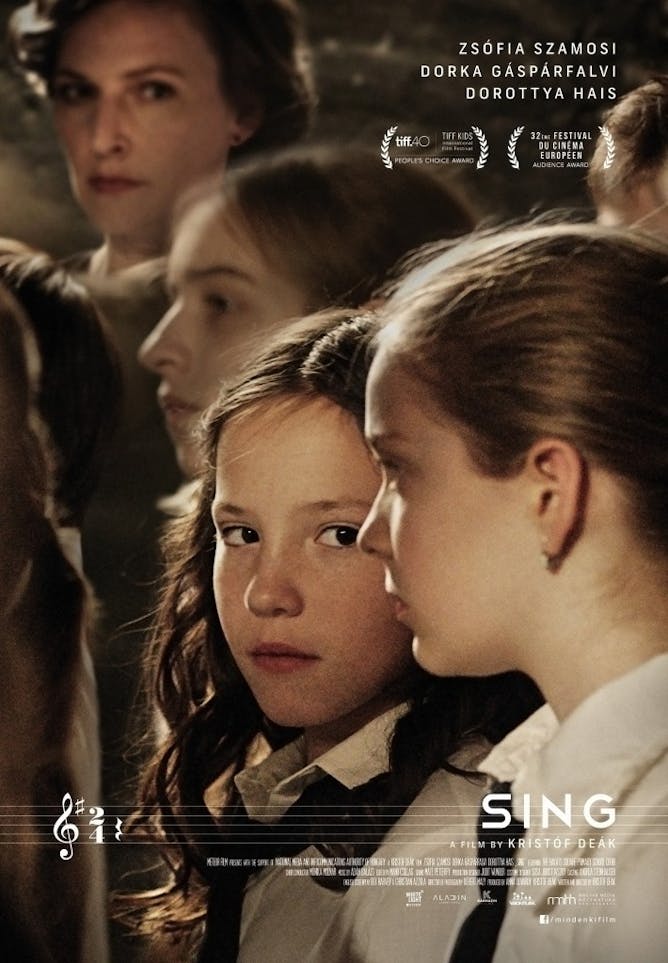
A Hungarian film titled “Sing” recently won the Oscar for best short film. “Sing” tells the story of young Zsófi, who joins a renowned children’s choir at her elementary school where “everyone is welcome.” Soon after joining, Zsófi is told by her teacher Erika not to sing, but only mouth the words. On the face of it, she accepts her teacher’s request stoically. But later in the movie, her anguish and pain become obvious, when she reluctantly tells her best friend what happened. The movie goes on to reveal that Zsófi isn’t the only choir member who has been given these hurtful instructions. The choir teacher’s defense is, “If everybody sings we can’t be the best.”
I have been a professor of music education for the past 28 years, and I wish I could say that the story of a music teacher asking a student not to sing is unusual. Unfortunately, I have heard the story many times. In fact, research shows that many adults who think of themselves as “unmusical” were told as children that they couldn’t or shouldn’t sing by teachers and family members.
All children are musical
The 2017 Oscar-winning short film ‘Sing’ explores the experience of a child who is told not to sing. Meteor Films
Children are natural musicians, as they readily sing, dance and play music from the time they are infants. People ask me all the time how they can tell if their child has musical talent. I assure them that their child – indeed every child – has musical ability that can be developed into a satisfying and lifelong relationship with music.
However, as they get older, some children begin to get messages from peers, family members, the media and (unfortunately) music teachers that they may not be very musical – that they don’t have “talent.”
The ‘talent’ mindset
Shows like “American Idol” have promoted the notion that singing is a rare ability reserved for the talented few, and that those without such talent entertain us only by being ridiculed and weeded out.
This “talent mindset” of music runs counter to what psychologist Carol Dweck calls the “growth mindset” that is considered critical for learning: Students who view their success as a result of hard work will persevere through challenges, while students who believe their success lies with some innate ability – like “talent” – are more likely to give up. My own research found that if children have a negative view of themselves as singers, they are much less likely to participate in music of any kind.
These self-perceptions of a lack of musical talent can then become a self-fulfilling prophecy. Research shows that adults who dropped out of music as children may lose their singing skills through lack of use and opportunity. Kids who love music but do not think of themselves as musical could miss out on many of the social and cognitive benefits of music participation, on the experience of feeling connected to others through song. These benefits have nothing to do with talent.
The 2016 ‘American Idol’ finalists, La’Porsha Renae and Trent Harmon (winner). Fox
Get children singing
How can we send children the message that singing is for everyone? I argue that change could begin both at home and at school.
For example, if you are a parent, you could sing the music you loved growing up and not worry about how good you sound. Having an adult in the home committed to music and singing without shame may be the most powerful influence on a child. You could sing with your kids from the time they are little, sing with the radio, sing in the car or sing at the dinner table.
As for my fellow music teachers, I ask that you encourage all of the children in your classrooms, schools and communities to sing whenever and wherever they get a chance. The sad truth is, when we, the musical experts, discourage a child from singing, it can deliver a fatal blow to the child’s musical self-image.
Music teachers need to teach in a climate of collaboration and participation where all voices are heard and valued – not one of audition and competition where only the best can sing.
The movie “Sing” is actually titled “Mindenki” in Hungarian, which means “Everybody.” That’s the uplifting message that Zsófi and her choir mates teach Miss Erika in the end. Singing is not reserved for the few: Either everybody sings or nobody should.
The following is from a recent article in The Guardian written by Wendy Berliner. We found it particularly interesting and relevant to families involved in Suzuki training. One gem from the article,
“Einstein, the epitome of a genius, clearly had curiosity, character, and determination. He struggled against rejection in early life but was undeterred. Did he think he was a genius or even gifted? No. He once wrote: “It’s not that I’m so smart, it’s just that I stay with problems longer. Most people say that it is the intellect which makes a great scientist. They are wrong: it is character.” For the full article, click here. Enjoy!
—
When Maryam Mirzakhani died at the tragically early age of 40 this month, the news stories talked of her as a genius. The only woman to win the Fields Medal – the mathematical equivalent of a Nobel prize – and a Stanford professor since the age of 31, this Iranian-born academic had been on a roll since she started winning gold medals at maths Olympiads in her teens.
But look closer and a different story emerges. Mirzakhani was born in Tehran, one of three siblings in a middle-class family whose father was an engineer. The only part of her childhood that was out of the ordinary was the Iran-Iraq war, which made life hard for the family in her early years. Thankfully it ended around the time she went to secondary school.
Mirzakhani, did go to a highly selective girls’ school but maths wasn’t her interest – reading was. She loved novels and would read anything she could lay her hands on; together with her best friend she would prowl the book stores on the way home from school for works to buy and consume.
As for maths, she did rather poorly at it for the first couple of years in her middle school but became interested when her elder brother told her about what he’d learned. He shared a famous maths problem from a magazine that fascinated her – and she was hooked. The rest is mathematical history.
Is her background unusual? Apparently not. Most Nobel laureates were unexceptional in childhood. Einstein was slow to talk and was dubbed the dopey one by the family maid. He failed the general part of the entry test to Zurich Polytechnic – though they let him in because of high physics and maths scores. He struggled at work initially, failing to get academic post and being passed over for promotion at the Swiss Patent Office because he wasn’t good enough at machine technology. But he kept plugging away and eventually rewrote the laws of Newtonian mechanics with his theory of relativity.
Lewis Terman, a pioneering American educational psychologist, set up a study in 1921 following 1,470 Californians, who excelled in the newly available IQ tests, throughout their lives. None ended up as the great thinkers of their age that Terman expected they would. But he did miss two future Nobel prize winners – Luis Alvarez and William Shockley, both physicists – whom he dismissed from the study as their test scores were not high enough.
There is a canon of research on high performance, built over the last century, that suggests it goes way beyond tested intelligence. On top of that, research is clear that brains are malleable, new neural pathways can be forged, and IQ isn’t fixed. Just because you can read Harry Potter at five doesn’t mean you will still be ahead of your contemporaries in your teens.
According to my colleague, Prof Deborah Eyre, with whom I’ve collaborated on the book Great Minds and How to Grow Them, the latest neuroscience and psychological research suggests most people, unless they are cognitively impaired, can reach standards of performance associated in school with the gifted and talented. However, they must be taught the right attitudes and approaches to their learning and develop the attributes of high performers – curiosity, persistence and hard work, for example – an approach Eyre calls “high performance learning”. Critically, they need the right support in developing those approaches at home as well as at school.
Maryam Mirzakhani won the Fields Medal, the mathematical equivalent of the Nobel prize, but showed little maths ability, to begin with. Photograph: Clay Mathematics Institute
So, is there even such a thing as a gifted child? It is a highly contested area. Prof Anders Ericsson, an eminent education psychologist at Florida State University, is the co-author of Peak: Secrets from the New Science of Expertise. After research going back to 1980 into diverse achievements, from music to memory to sport, he doesn’t think unique and innate talents are at the heart of performance. Deliberate practice, that stretches you every step of the way, and around 10,000 hours of it, is what produces the expert. It’s not a magic number – the highest performers move on to doing a whole lot more, of course, and, like Mirzakhani, often find their own unique perspective along the way.
Ericsson’s memory research is particularly interesting because random students, trained in memory techniques for the study, went on to outperform others thought to have innately superior memories – those you might call gifted.
He got into the idea of researching the effects of deliberate practice because of an incident at school, in which he was beaten at chess by someone who used to lose to him. His opponent had clearly practiced.
But it is perhaps the work of Benjamin Bloom, another distinguished American educationist working in the 1980s, that gives the most pause for thought and underscores the idea that family is intrinsically important to the concept of high performance.
Bloom’s team looked at a group of extraordinarily high achieving people in disciplines as varied as ballet, swimming, piano, tennis, maths, sculpture and neurology, and interviewed not only the individuals but their parents, too.
While the jury is out on giftedness being innate and other factors potentially making the difference, what is certain is that the behaviours associated with high levels of performance are replicable and most can be taught – even traits such as curiosity.
Eyre says we know how high performers learn. From that she has developed a high performing learning approach that brings together in one package what she calls the advanced cognitive characteristics, and the values, attitudes, and attributes of high performance. She is working on the package with a group of pioneer schools, both in Britain and abroad.
But the system needs to be adopted by families, too, to ensure widespread success across classes and cultures. Research in Britain shows the difference parents make if they take part in simple activities pre-school in the home, supporting reading for example. That support shows through years later in better A-level results, according to the Effective Pre-School, Primary and Secondary study, conducted over 15 years by a team from Oxford and London universities.
Eye-opening spin-off research, which looked in detail at 24 of the 3,000 individuals being studied who were succeeding against the odds, found something remarkable about what was going on at home. Half were on free school meals because of poverty, more than half were living with a single parent, and four in five were living in deprived areas.
The interviews uncovered strong evidence of an adult or adults in the child’s life who valued and supported education, either in the immediate or extended family or in the child’s wider community. Children talked about the need to work hard at school and to listen in class and keep trying. They referenced key adults who had encouraged those attitudes.
Einstein, the epitome of a genius, clearly had curiosity, character, and determination. He struggled against rejection in early life but was undeterred. Did he think he was a genius or even gifted? No. He once wrote: “It’s not that I’m so smart, it’s just that I stay with problems longer. Most people say that it is the intellect which makes a great scientist. They are wrong: it is character.”
And what about Mirzakhani? Her published quotations show someone who was curious and excited by what she did and resilient. One comment sums it up. “Of course, the most rewarding part is the ‘Aha’ moment, the excitement of discovery and enjoyment of understanding something new – the feeling of being on top of a hill and having a clear view. But most of the time, doing mathematics for me is like being on a long hike with no trail and no end in sight.”
The trail took her to the heights of original research into mathematics in a cruelly short life. That sounds like unassailable character. Perhaps that was her gift.
Great Minds and How to Grow Them, by Wendy Berliner & Deborah Eyre.
If you have a commute to work or a commute to just about anywhere and are a Suzuki parent, teacher or even an older student, this podcast is for you. It is done so artfully–beautiful music, thoughtful interviews, reflections, advice and so much more. Give it a listen!
“Bringing Your Gifts and Feeding a Hunger that the World Has.”—Episode 6
Angela Thompson is a violinist and violin instructor with training in the Suzuki Method of music education. She received her Bachelor’s Degree from the National Conservatory of Peru in violin performance. She has played as a soloist with the Cusco Symphony Orchestra and has taken master classes from internationally known violinists, such as Ray Chen and Rachel Barton.
Angela has over a decade of teaching experience. In 2015, she co-founded the Capulitaki School of Music in Lima, Peru, which currently teaches Classical and Latin American traditional music to children of all ages. Her students have participated in musical festivals, concerts, and institutes and have toured various cities throughout Peru. She has completed Suzuki training courses Books 1- 8 and enrichment courses with Nancy Lokken, Marilyn O'Boyle, Ann Montzka, Nancy Jackson, Fernando Piñero, and Carol Dallinger. She has also received training in the Dalcroze and Kodaly methods. She has taught at festivals and institutes around Peru, and was the elected Violin Coordinator of the Suzuki Association of Peru from 2015-2017.
She loves traveling, her two cats, and learning different styles of music. She occasionally dabbles in amateur theatre and dance.